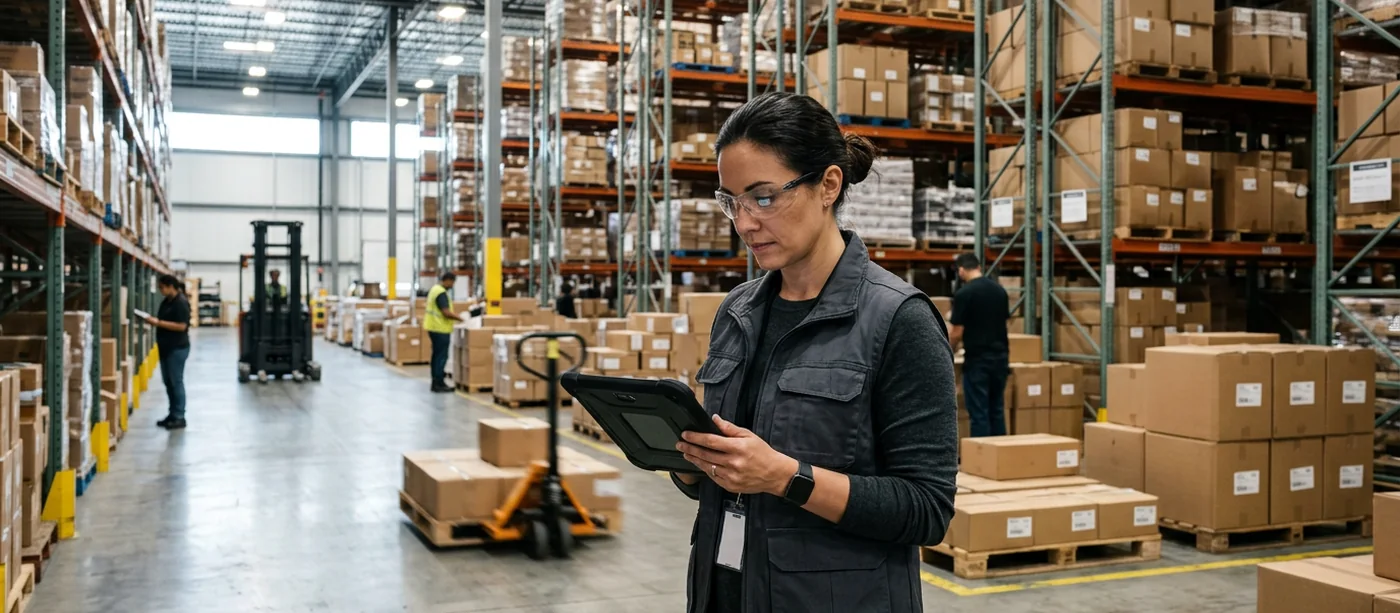
AI apps that remove the repetitive work on the warehouse floor.
Receiving teams hand-check every PO, re-type the same shortage notes, chase cycle-count variances, and lose time to verbal shift handoffs. AICG builds small, focused apps that eliminate those repeated tasks — and you can try a working one right on this page.
A warehouse runs on repetition: the same fields checked at receiving, the same count sheets filled, the same exception notes written by hand, the same status re-explained at every shift change. Individually each takes a minute; across a day and a team, it’s hours of re-keying and chasing — and the errors that slip through cost real money in inventory accuracy and vendor claims.
AICG removes one annoying, repeated task at a time. We build a small app that drafts the note, flags the mismatch, or structures the record — while a person stays in control of what’s approved — and connect it to the WMS, ERP, email, and spreadsheets you already run.
Live demo
Try the warehouse tool, right here.
A working example of an app we’d build and fit to your receiving process. Change a received quantity and watch it flag shortages and overages and draft the discrepancy note — no install, no sign-up.
Repetitive tasks we eliminate
Where applied intelligence can help.
Receiving discrepancies — compare the PO to what arrived, flag shortages/overages, auto-draft the claim note.
Cycle counts — log counts, prompt a recount when numbers look off, build the variance report.
Exception & damage logging — a photo and a quick note become a prefilled, routed incident report.
Shift handoffs — turn end-of-shift notes into a clean summary of unresolved issues and priorities.
Returns & put-away notes — structure the recurring paperwork people re-type every day.
SOP & code lookups — the right procedure or product code, one question away.
Funding programs to watch
Funding-aware project framing.
Canada Digital Adoption Program (CDAP) successor streams
NRC IRAP advisory and project support
Regional development agency funding (e.g. FedDev Ontario)
Program names are directional research signals, not eligibility advice or approval guarantees.
What a first engagement looks like.
We pick one task that costs real time today — receiving discrepancies are a common first win — and map exactly how it flows from the dock to the final note or claim. We quantify the manual effort and error risk, then build an app that drafts and flags automatically while a person approves the result.
We plan around how a warehouse really runs: barcodes and paper, busy docks, intermittent devices, and data in many formats. The deliverable is a working tool plus a clear view of whether — and where — it makes sense to roll it to other docks, sites, or shifts.
How AICG helps
Turn one repetitive task into a scoped, measurable app.
Find the task that repeats dozens of times a day
Build a small app that drafts, flags, or structures it
Keep a human in control of what gets approved
Prove the time, accuracy, and claim-speed payback before scaling
Warehouse & logistics AI: common questions.
What warehouse tasks can a small AI app actually help with?
The best targets are repetitive, daily tasks: comparing a PO to what arrived, logging cycle-count variances, writing damage and shortage reports, and turning shift notes into a clean handoff. Each is a small, governed app — not a giant WMS replacement.
Do we need to replace our WMS or ERP?
No. These apps sit beside the systems you already run and feed them — they remove a manual step, not your platform. We integrate with your WMS, ERP, email, and spreadsheets.
Is this just for big distribution centers?
No. The smaller the team, the more a single repetitive task hurts. We start with one workflow that costs real time today and prove the payback before scaling.
Can we try one before committing?
Yes — the Receiving Match demo on this page is a working example you can use right now. A real build is the same idea fitted to your POs, SKUs, approvals, and systems.
Start with one repetitive task.
The strongest warehouse apps begin with one repeated job where the team can compare time, accuracy, claim speed, or count error before and after — then decide what to scale.